

Optimising Seagrass Restoration for Wildlife: From Science to Strategy in Denmark’s Vejle Fjord
- Posted by Akshata Mehta
- On June 12, 2026
Seagrasses are among the ocean’s most important ecosystems, yet they have been disappearing globally at alarming rates. In Denmark’s Vejle Fjord, decades of eutrophication had reduced seagrass from depths of 10 to just 2.5 metres, with drastically reduced coverage. Restoration efforts began in 2019, but a critical question remained unanswered: were the restored habitats actually supporting the animals that depend on them?
A collaboration between the Global Wetlands Project and Southern Denmark University led by Dr Michael Sievers developed a research program to tackle this question, and the answers are reshaping how restoration is practised and evaluated.
The team surveyed 132 sites across bare sand, restored seagrass of different ages, and natural seagrass meadows. They found that animals such as fish, crustaceans, and marine snails moved into the restored seagrass quickly. Within just two years, restored sites supported animal communities similar to those found in natural meadows, even when the restored seagrass was less dense. The team also looked beyond animal numbers. By studying the health and condition of pipefish, they showed that animals living in restored seagrass were doing just as well as those in natural habitats. This confirmed that restored seagrass was not only attracting wildlife, but providing good-quality habitat.
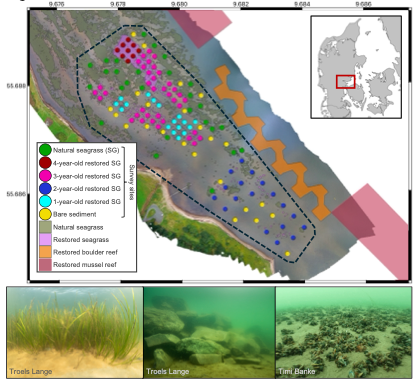
Drone imagery of the study area in Vejle Fjord, Denmark, showing the distribution of natural seagrass, restored seagrass, boulder reef, and mussel reef, the location of the 132 survey sites, and the approximate region used for the seascape modeling (shown as a dashed-lined polygon). Below are images of the restored seagrass, boulder reef, and mussel reef.
These findings carry immediate practical significance. Restoration practitioners and natural capital assessors have historically built in lengthy time lags before counting biodiversity benefits from seagrass restoration. This research demonstrates those lags may be unnecessary for seagrass in comparable settings, strengthening the economic and ecological case for continued investment.
But the team did not stop there. Working within what is one of the world’s largest multi-habitat restoration seascapes encompassing restored seagrass, boulder reefs, and mussel beds, they asked not just whether restoration works, but how restored habitats should be spatially configured to maximise outcomes. By combining animal monitoring data with spatial modelling, the team found that restoration works best when seagrass is planted strategically rather than evenly across an area. Patchy planting arrangements often delivered better outcomes for animals than uniform coverage. The results also showed that nearby restored mussel beds and boulder reefs can influence biodiversity, reinforcing the value of planning restoration across multiple habitats. Importantly, there was no single “best” design for every species. The ideal arrangement depended on the species or restoration goal being prioritised, showing why projects need clear objectives from the outset.
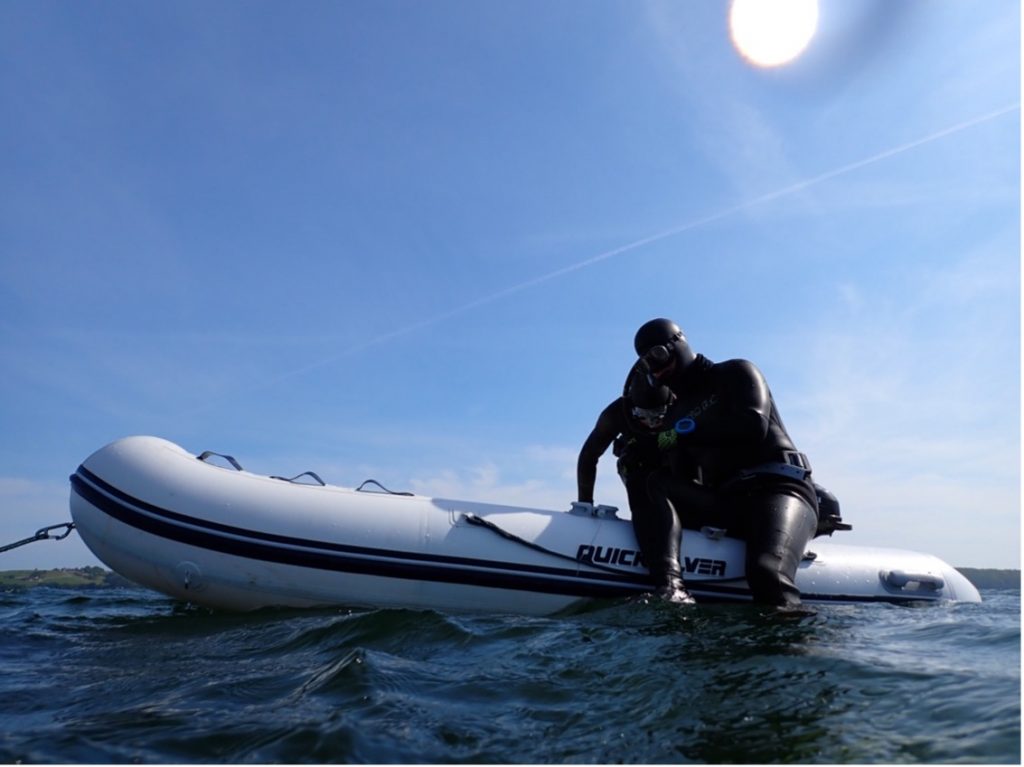
Surveying fauna in Vejle Fjord, Denmark.
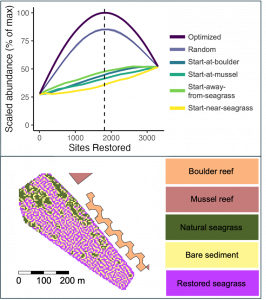
Top: Predicted abundance of the lesser pipefish (Sygnathus rostellatus) as more and more bare sediment is restored to seagrass. Bottom: Where restoration should take place to maximise the abundance of lesser pipefish.
The practical upshot is elegantly simple: plant patchy, plant strategically, and set clear objectives. The code underpinning the spatial framework has been made openly available, enabling practitioners globally to adapt the approach to their own restoration seascapes.
Together, these studies, published in Restoration Ecology and Ecological Applications, represent a step-change in how animal outcomes are incorporated into seagrass restoration science and planning, moving from passive monitoring to active optimisation, and from population counts to individual-level health assessment. The work directly informs ongoing restoration in Vejle Fjord and provides a transferable, evidence-based framework for coastal managers worldwide working to reverse the tide of seagrass loss. The team is now working to expand this work to the many fjords currently being restored around Denmark.
References
Sievers M, Brown C, Rasmussen J, Nielsen B, Steinfurth R, Flindt M, Banke T, Gilby B, Connolly R (2025). Optimizing seagrass planting arrangements for animal benefits in a multi-habitat restoration seascape. Ecological Applications. 35(8), e70163.
Sievers M, Rasmussen JA, Nielsen B, Steinfurth RC, Flindt MR, Melvin SD, Connolly RM (2025). Restored seagrass rapidly provides high-quality habitat for mobile animals. Restoration Ecology, 33(1), e14343.
0 Comments